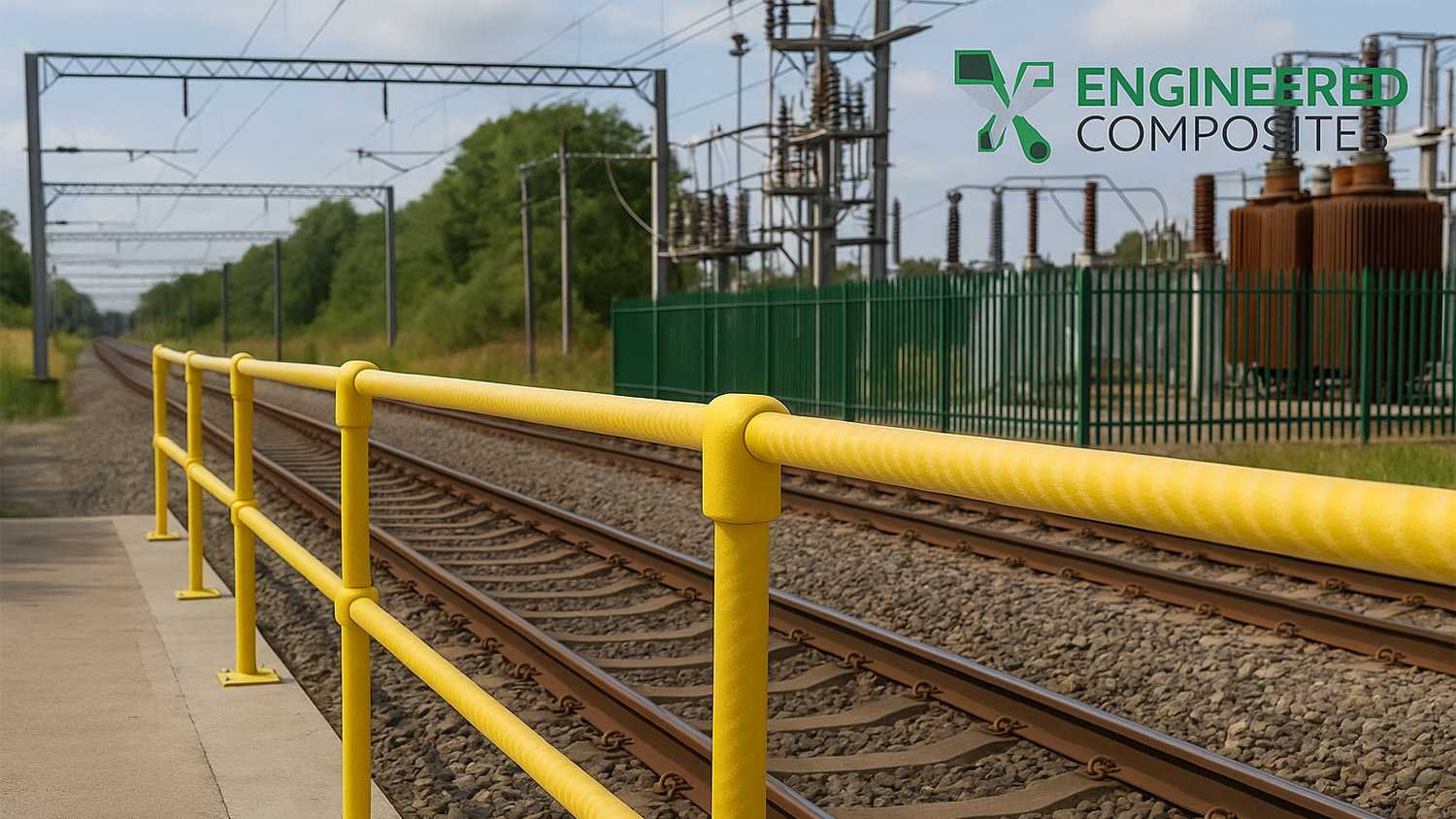
UK rail operators and contractors are increasingly turning to Glass Reinforced Plastic (GRP) for handrails, walkways, and other trackside safety systems to address one of the sector’s most pressing challenges: completing upgrade and maintenance work within tight possession windows while keeping long-term operational costs under control.
Possession overruns can have a ripple effect across the entire network, delaying services, increasing operational costs, and in some cases triggering contractual penalties. Rail teams are under pressure to complete complex works quickly without compromising safety or quality. GRP offers a combination of material properties and installation advantages that directly support these operational goals.
Unlike steel, GRP is significantly lighter, allowing sections to be carried manually to site without the need for cranes or heavy lifting equipment. This not only removes set-up time for plant but also allows work to continue in locations with restricted access where traditional materials would be more difficult to handle. Prefabrication further accelerates installation, with GRP panels, handrails, and structural sections arriving pre-cut and pre-drilled, ready for assembly with basic tools. Installations that might otherwise require multiple possessions can often be completed in a single shift.
In electrified areas, GRP’s non-conductive properties remove the need for earthing, eliminating a work stage that can extend possessions and require additional electrical isolation. This is particularly valuable for upgrades near overhead line equipment and live track circuits, where isolations can be complex to arrange and disruptive to operations.
Beyond installation speed, GRP delivers operational savings through its resistance to corrosion, UV degradation, and vibration fatigue. Steel systems in exposed trackside environments can require repainting and corrosion repair every few years, each time demanding a possession and adding cost. GRP avoids these interventions entirely, with maintenance limited to periodic cleaning and inspection. Over a 50-year service life, this can cut total lifecycle costs by around 40 to 50 percent compared to steel, and reduce possession-related maintenance by a similar margin.
Integration with existing infrastructure is another area where GRP offers benefits. Systems can be fabricated to match the dimensions and connection points of existing walkways, bridge structures, or platform edges, reducing on-site adjustments that can slow down projects. This
compatibility means upgrades can be delivered with minimal disruption and without the need for major alterations to adjacent structures.
For rail operators and contractors, the combination of faster installation, reduced isolation requirements, and lower maintenance intervention translates into higher asset availability and lower total cost of ownership. The result is a safer, more reliable network delivered within tighter operational schedules.
Further technical information and case studies on GRP in rail applications are available from Engineered Composites, the UK’s largest independent supplier of GRP products for industrial and infrastructure sectors.