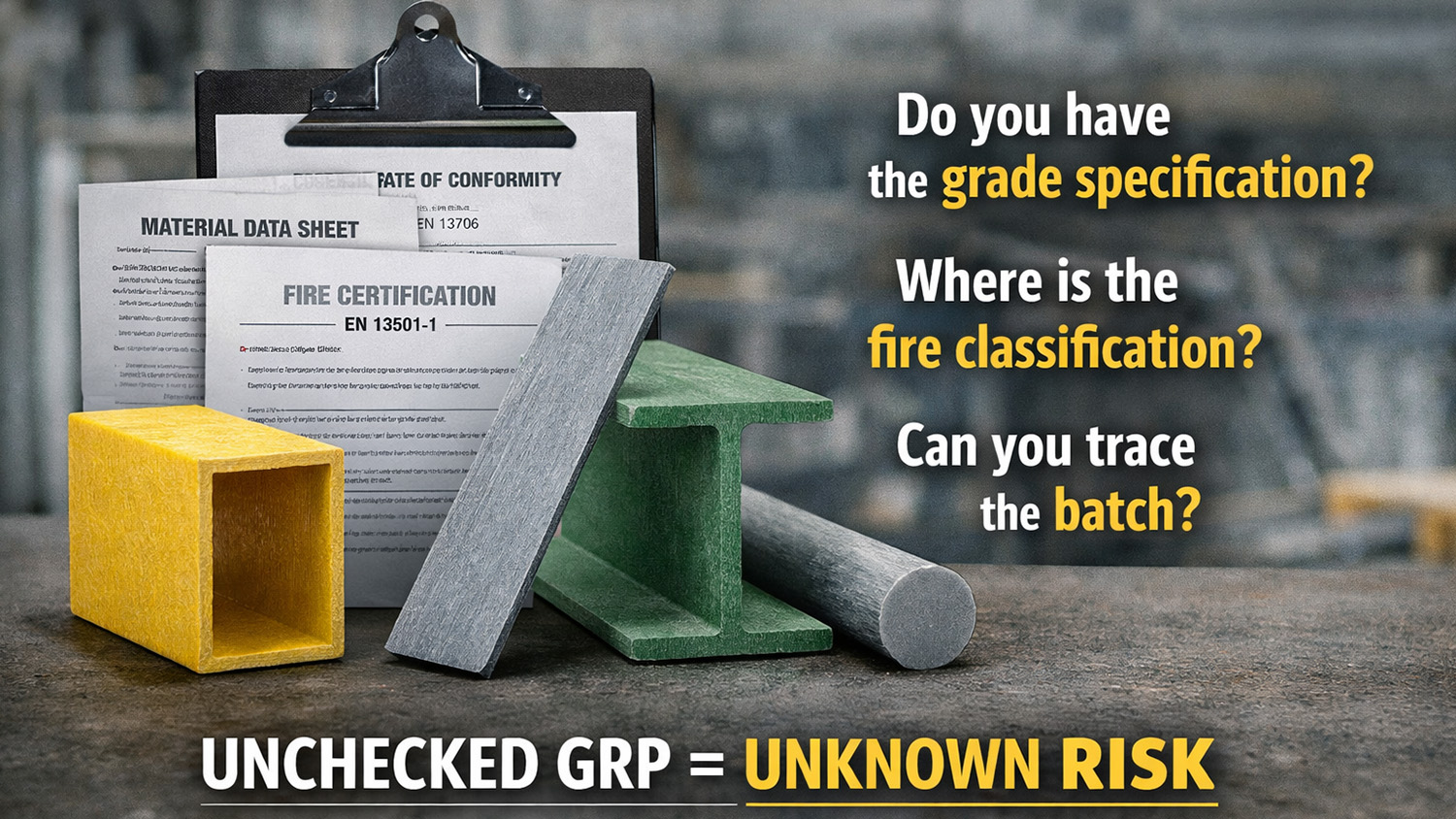
As Glass Reinforced Plastic continues to gain traction across infrastructure, rail, utilities and marine projects, industry leaders are urging greater awareness of the standards governing its specification and performance.
GRP is now widely used in handrails, walkways, fencing, structural profiles and reinforcement applications, often in high risk or corrosive environments where long term durability and safety are critical. Yet despite its growing adoption, confusion remains around fire classification, structural loading requirements and material traceability.
Mr Gavin Williams, Managing Director of Engineered Composites and Vice Chair of Composites UK, believes the sector must treat GRP with the same technical discipline applied to traditional construction materials.
“GRP is no longer a niche alternative,” Mr Williams said. “It is being specified in critical infrastructure. That means designers, contractors and asset owners need clarity around exactly what standards apply, what the classifications mean, and what documentation they should expect.”
Fire Standards Have Shifted
One of the most significant areas of change has been fire classification. Historic UK test methods such as BS 476 have increasingly been replaced by European classification under EN 13501-1, which evaluates contribution to fire, smoke production and flaming droplets or particles.
Mr Williams notes that many specifications still reference outdated standards or fail to request full classification detail.
“If a product is described as fire retardant, the next question should be to what standard and with what classification,” he said. “The main class, smoke rating and droplet performance all matter.”
Structural Compliance Is Not Optional
Pultruded load bearing profiles fall under EN 13706, which defines mechanical properties, testing methodology and dimensional tolerances. However, awareness of these requirements is inconsistent across projects.
In applications such as elevated walkways, access platforms and perimeter systems, loading performance and deflection control are fundamental to safety.
“GRP handrails and grating systems must be engineered and tested to defined loading criteria,” Mr Williams explained. “Assumptions or generic claims are not enough when public safety is involved.”
Performance in Aggressive Environments
GRP’s resistance to corrosion is one of its primary advantages, particularly in coastal, chemical and high humidity environments. In reinforcement applications, it offers a non corrosive alternative to steel in marine and infrastructure settings.
However, Mr Williams stresses that performance must still be evidenced through material data, mechanical values and quality control systems.
“Resin system, fibre content, tensile strength and bond performance all influence suitability,” he said. “Without traceable data, it becomes very difficult for engineers to make informed comparisons.”
Carbon Transparency Is Rising Up the Agenda
Beyond structural and fire compliance, embodied carbon and lifecycle assessment are increasingly shaping procurement decisions. Environmental Product Declarations and carbon transparency are becoming standard expectations on major projects.
“Lifecycle performance and durability are central to sustainable construction,” Mr Williams added. “If materials are being selected on carbon grounds, they should be supported by credible, transparent data.”
With GRP now firmly embedded within mainstream construction, Mr Williams believes alignment across manufacturers, specifiers and contractors is essential.
“We have robust standards in place,” he said. “The challenge is ensuring they are understood and applied consistently. When that happens, GRP delivers safe, durable and high performing solutions across the built environment.”
Further technical guidance on GRP standards and compliance is available through industry bodies and specialist manufacturers.