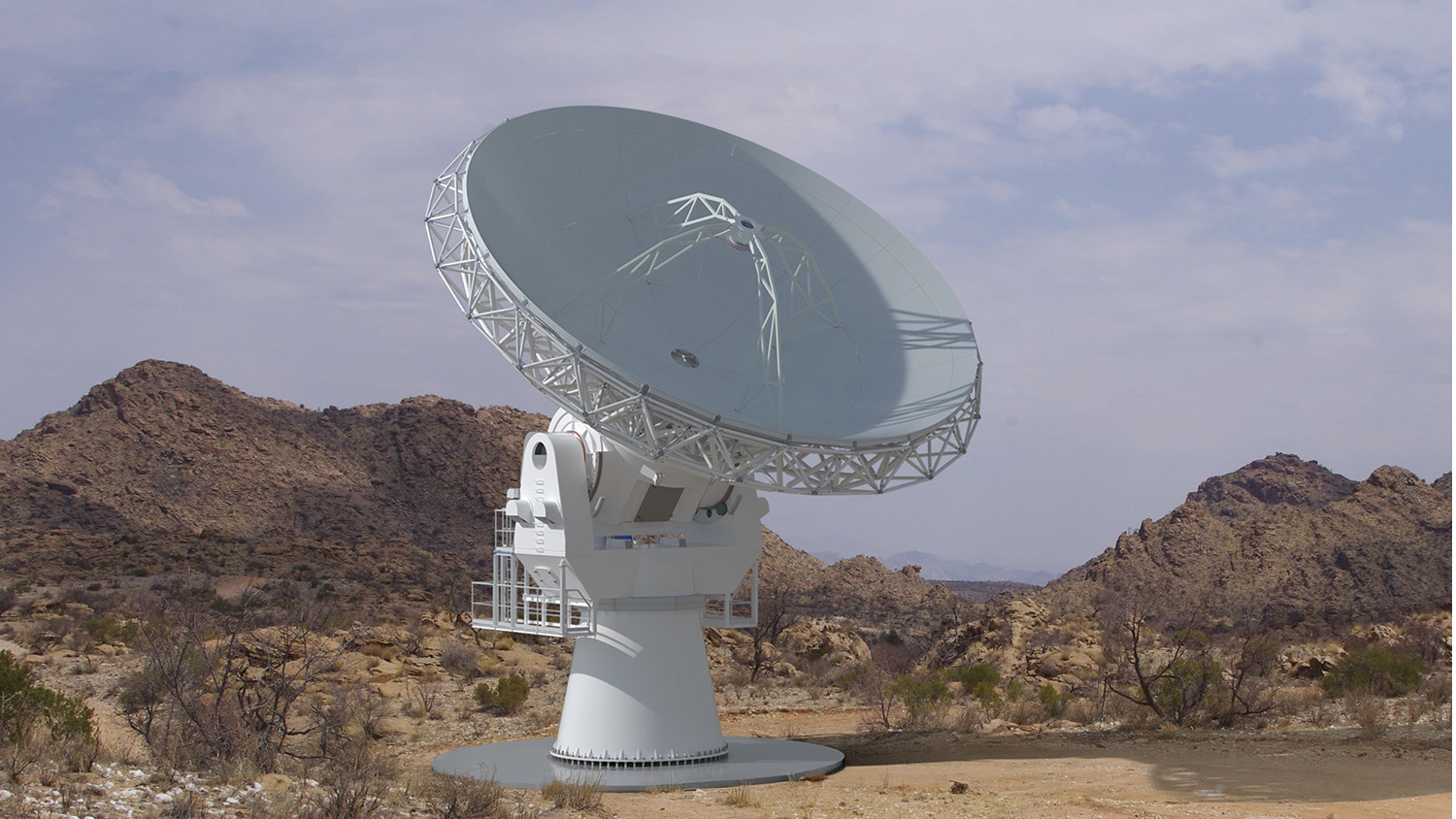
True 0° axial fibre placement delivers the axial stiffness and thermal stability required for millimetre-wave observing at 86–350 GHz
Compo Tech PLUS, spol. s r.o. has been awarded a contract by mtex antenna technology GmbH to manufacture carbon fibre (CF) composite struts for the backup structure (BUS) of the Africa Millimetre Telescope (AMT). The AMT will be the first African node of the Event Horizon Telescope (EHT) network, located in Namibia.
mtex antenna technology, which specialises in high-precision reflector antenna systems, was selected by the AMT consortium to further develop a proven telescope design and build the telescope specifically for the AMT project. The design uses CF composite struts in the backup structure to minimise thermally induced dimensional change, a major design challenge for metal structures at a site with large day–night temperature swings.
The AMT is a robotically operated 14-metre dish optimised for 86–350 GHz and capable of observing down to 8 GHz. It will be built near the H.E.S.S. observatory close to the Gamsberg Table Mountain in Namibia, and is intended to be relocated to the Gamsberg plateau once infrastructure is complete.
CompoTech is supplying several hundred AFL-wound CF composite strut tubes with bonded metallic end fittings, produced at its design and manufacturing facility in Sušice, Czech Republic. In addition to limiting thermal expansion and contraction, the BUS struts provide high axial stiffness and natural damping, which help to maintain the positioning accuracy of the telescope.
The AMT consortium is led by Radboud University together with the University of Oxford, the University of Amsterdam, the University of Turku, the University of Namibia and the University of South Africa.
Why fibre orientation decides reflector accuracy
At millimetre wavelengths, reflector surface accuracy governs sensitivity. The BUS must hold the reflector geometry against self-weight, wind loading and the thermal cycle of a desert day and night. Steel and aluminium expand and contract enough to require continuous compensation. Conventional filament winding is limited to wind angles between 7 and 12 degrees, so it cannot place continuous fibre at a true 0° axial orientation and cannot fully exploit the modulus of ultra-high modulus fibre along the strut axis.
CompoTech’s Automated Fibre Laying (AFL) places continuous fibre at a true 0° axial orientation, allowing every laminate layer to be oriented to the actual load path. Using 760 GPa ultra-high modulus pitch carbon fibre, a conventionally wound laminate reaches an effective axial modulus of approximately 260 GPa; the AFL laminate architecture raised the axial modulus to 360 The same pitch fibre gives a near-zero coefficient of thermal expansion along the strut axis limiting thermally induced dimensional change. Analysis of the complete main reflector structure under the defined load cases showed deformation of approximately 50 μm.
Ondřej Uher, Founder and R&D Director of CompoTech PLUS, commented: “A millimetre-wave reflector is a design engineering dilemma between stiffness and thermal stability, which can be overcome using fibre architecture rather than the choice of material. Placing ultra-high modulus pitch fibre at a true 0° along each strut axis is what allows the backup structure to hold reflector geometry through a Namibian day–night cycle. It is the same true 0° AFL technology we use in semiconductor positioning structures that hold 0.5 μm accuracy at 5g, and we are pleased to also be supporting mtex antenna technology and the AMT consortium with it for this new telescope.”
Dr Jens Bormann, COO, mtex antenna technology, said: “The Africa Millimetre Telescope demands for structural stability and precision, particularly given the challenging environmental conditions at the site. With CompoTech’s expertise in advanced carbon composite structures and axial fibre placement we have a strong partner to meet these requirements. Their manufacturing capabilities in Europe enable production under controlled conditions, supporting the consistency required for this project. We value this collaboration and look forward to contributing together to the successful realisation of the Africa Millimetre Telescope.”
Website: www.compotech.com