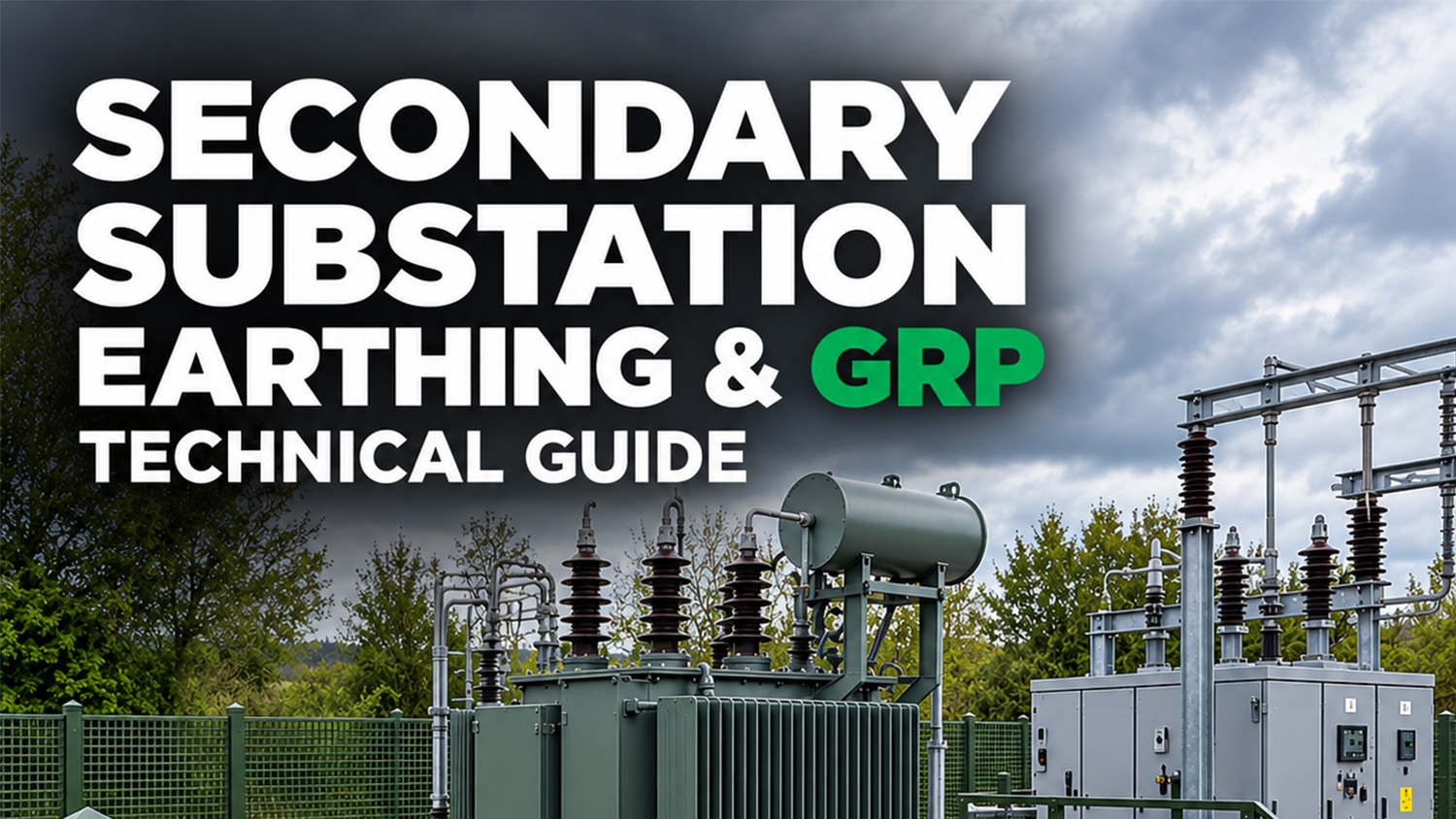
New guide shows designers, ICPs and contractors where GRP removes bonding and grading work that exists only because site materials are metallic
Chester-based GRP manufacturer Engineered Composites Ltd (ECL) has published a free technical guide for engineers working on secondary substations, setting out where non-conductive materials can simplify earthing compliance under UK Power Networks standard EDS 06-0014.
The guide arrives as distribution networks add and upgrade secondary substations to support heat pumps, EV charging and new connections. Every one of those sites has to manage earth potential rise during a fault. Once a site is classed as HOT, with an EPR above 430V, the obligations reach well beyond the transformer to the fence line, doors, access routes and ducts. Metallic items close to earthed equipment have to be bonded, separated or insulated, and that work often surfaces late, after a fence or door package has already been let.
Written for designers, planning engineers, ICPs, IDNOs and principal contractors, the guide does two things. Part one condenses the standard into the sequence an engineer works in: design requirements, calculation steps, standard arrangements, installation and metalwork rules. Part two asks a narrower question: which obligations exist only because the item is metallic, and what happens when it is not.
The answer is that the standard already anticipates non-conductive solutions. It names insulated operator platforms, insulated ducts, insulating barriers and insulating fence panels as accepted options, and excludes metal frames forming part of a GRP enclosure or supporting GRP grating from the bonding requirement. On a HOT site, a GRP compound fence removes the need for panel bonding, gate bonds and a buried grading electrode along the fence line, while GRP doors and frames remove the grading loop and concrete cover under the doorway.
The guide is equally candid about limits. GRP does not lower earth resistance or EPR, insulating barrier claims need test evidence, and fire performance must be specified deliberately. It gives particular attention to GFRP rebar, explaining that substituting it for steel reinforcement in a substation base without revisiting the earthing design removes part of the grading function the design relies on, and it sets out a compliant hybrid approach using a dedicated bonded mesh. A worked cost comparison for a HOT-site compound fence and a section on what a structural engineer will need when designing with GFRP are also included.
Gavin Williams, Managing Director of Engineered Composites and Vice Chair of Composites UK, said: “The earthing consequences of a material choice are nearly always discovered after the choice has been made. A fence, door or duct changed at design stage costs nothing. Changed after the earthing design has been submitted, it costs a resubmission, and after installation it costs an excavation. GRP does not change the electrical design, and the 10 ohm and 430V questions stay exactly the same. What it does is take whole categories of bonding, grading and inspection off the site altogether. We wrote this guide so designers can see that early and make the decision with the full picture in front of them.”
The Secondary Substation Earthing and GRP guide is free to download here.