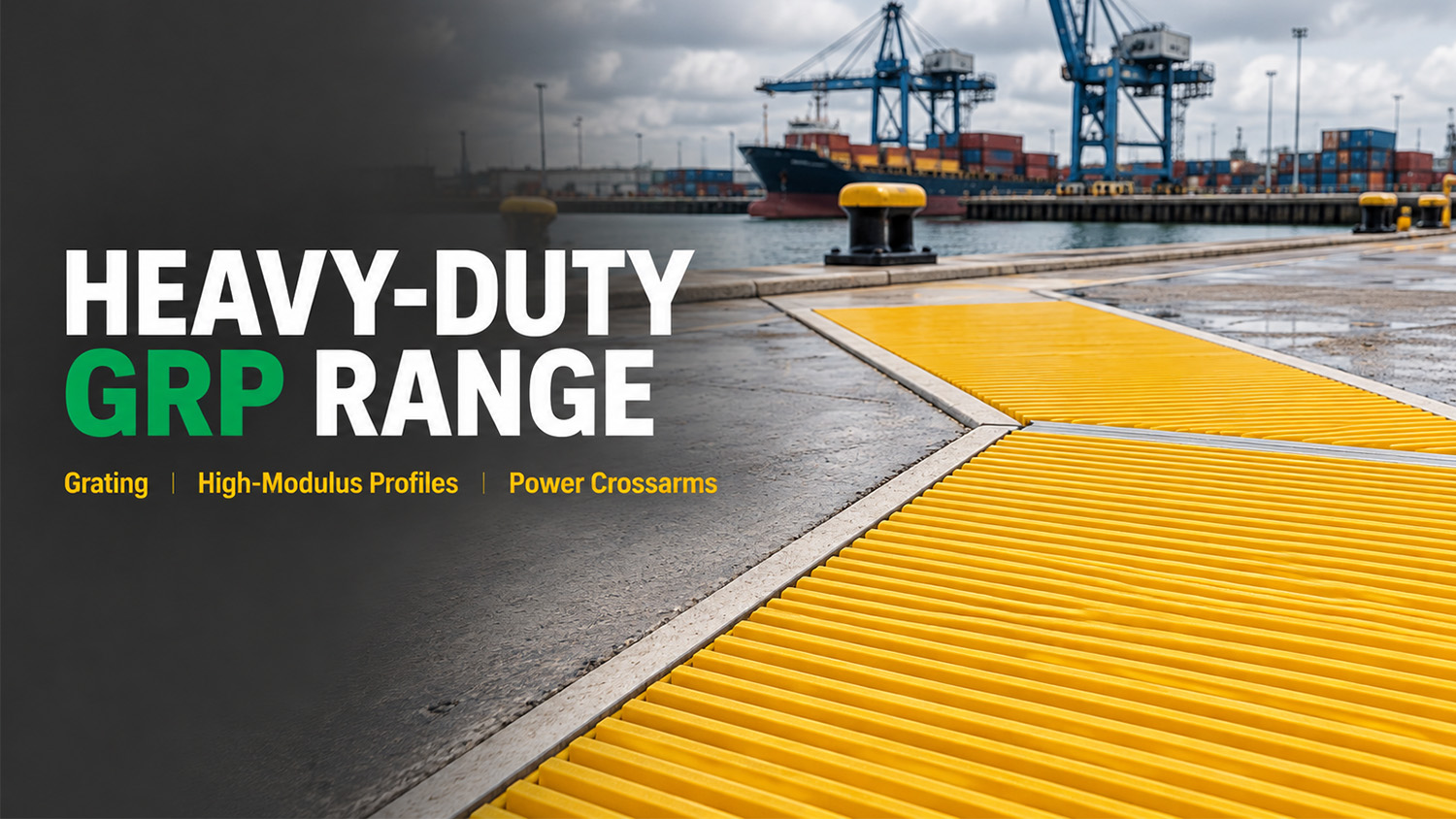
Engineered Composites Ltd (ECL), the Chester-based manufacturer and stockholder of glass reinforced plastic (GRP), has launched a Heavy-Duty GRP Range that moves the material into three markets where steel and concrete have held on the longest: vehicle-rated trench covers, deflection-critical primary structure and insulating crossarms for overhead power lines.
The range comprises heavy-duty pultruded grating rated to EN 124, high-modulus structural profiles with around 1.6 times the stiffness of a standard pultrusion, and machined GRP power crossarms tested to 120 kV. Each product was developed in response to the questions ECL is asked most often and, until now, has been least able to answer.
“For most of the forty years Engineered Composites has been supplying GRP, the conversation with engineers has followed a familiar pattern,” said Gavin Williams, Managing Director of Engineered Composites. “They know pultruded profiles won’t corrode, won’t conduct and weigh a fraction of steel. What they worry about is stiffness, load rating and whether the material can take real punishment. These three products address each of those objections head on.”
Heavy-duty grating: GRP where the vehicles run
GRP grating has always been a pedestrian product, specified for walkways, platforms and stair treads. Trench covers in yards, ports and car parks have stayed steel or concrete because few engineers trusted a composite panel under a forklift.
ECL’s new heavy-duty grating changes that. Built from E-glass reinforced vinyl ester load bars locked together with GRP cross rods, the 100mm-deep panels are rated to EN 124 load classes B125 and C250 for pedestrians, cars, forklifts and light trucks. Panels run from 500 to 1600mm long and 400 to 1000mm wide across common clear spans of 400 to 1400mm, in yellow, black or grey with an optional bonded anti-slip grit surface.
The difference shows over the life of the asset. A steel trench cover on a quayside starts rusting the day it is installed, needs regular repainting and is eventually lifted out and replaced. Concrete covers crack, chip and are heavy to lift for cable access. GRP heavy-duty grating is 50 to 80% lighter than either, so covers can be lifted and reinstated by hand without cranes. It will never corrode in salt-laden air and it has no scrap value for thieves. For ports, wharves, substations and logistics yards, that is a different maintenance model altogether.
High-modulus profiles: closing the stiffness gap
For engineers designing in GRP, strength is rarely the limiting factor. A standard pultrusion is well over 200 MPa in bending, but its 23 to 28 GPa modulus means deflection governs almost every design, and sections end up oversized or doubled up to keep spans within L/200 or L/250.
ECL’s high-modulus range uses high-performance glass reinforcement to lift flexural modulus to 42 GPa and tensile modulus to 50 GPa, with independent coupon testing recording 860 MPa flexural strength and 708 MPa tensile strength. Six standard heavy-wall sections run from a 100 x 100mm square tube to a 380 x 140mm twin-cell rectangular tube, with 10 to 15mm walls and lengths up to 6m as standard.
That is stiff enough to treat GRP as genuine primary structure: platform frames, footbridge stringers, cable-management supports and long-span walkway beams. A designer can now meet a deflection limit with a single GRP member rather than a fabricated pair, keeping the weight advantage for installation and avoiding the galvanising, painting and inspection regime that comes with steel in chemical plants, coastal structures and water treatment works.
GRP power crossarms: the whole-life argument in one product
The UK’s overhead line networks sit on hundreds of thousands of wood poles, most fitted with galvanised angle-steel crossarms. They corrode, they need periodic replacement and they are increasingly stolen for scrap. Every replacement means a line outage, a crew and a lift.
ECL’s machined GRP crossarms address all of that at once. They are fully electrically insulating, with dry and wet power-frequency withstand of 120 kV to IEC 60383 and lightning impulse performance to IEC 60071-1. They are rated UL 94 V-0 for fire, come through accelerated UV ageing to ASTM G154 without chalking or peeling, and will not corrode in coastal or polluted air. Arms are supplied in 75, 100 and 125mm square sections at 2400mm long, pre-drilled to the network operator’s hole pattern and ready to bolt to the pole.
“The unit price is higher than angle steel, and we say that openly, because the case does not rest on unit price,” said Mr Williams.
“It rests on the arm still being there, unchanged, in twenty years, and on the outages, crews and replacement stock that never had to be scheduled. For network operators under pressure on reliability and asset life, that is where the value is.”
From “not quite there” to the better choice “
Each of these products takes a market segment where the honest answer used to be ‘GRP isn’t quite there’ and moves it into ‘GRP is now the better choice’,” Mr Williams added. “Heavy traffic loads, primary structural stiffness and high-voltage electrical duty were the three areas we were most often asked about and least able to serve. We can now serve all three, with the same technical support, quality system and bespoke fabrication our customers already rely on.”
All three products are made to order, with bespoke lengths, sections, drilling patterns and finishes available.