The composites industry is not short of material innovation. New resin systems, fibres, recycled feedstocks, process technologies and digital tools continue to extend what composite structures can do. The more difficult challenge is often what happens next: moving a technically credible idea into repeatable, certifiable and commercially viable production.
That gap between innovation and industrial adoption is where many promising technologies stall. A material can offer exceptional mechanical properties and still struggle if processing is inconsistent, inspection is difficult, cycle time is too long, repair is unclear, or the supply chain cannot support the required rate. In sectors such as aerospace, automotive, energy and defence, performance is only one part of the qualification case.
This is why the development of composites increasingly has to be considered a manufacturing-system problem rather than a material problem alone. Material choice affects tooling, automation, joining, inspection and end-of-life. Production rate influences process selection. Digital simulation can accelerate development, but the model still has to reflect the realities of manufacturing. Recycling ambitions are shaped through choices made years earlier in design.
Alan Harper of Alan Harper Composites makes a simple but important point concerning collaboration: it only works when companies understand what the industry actually wants. For material innovators, that means engaging with manufacturers and end users early enough to understand the constraints that will determine adoption. A solution that requires a completely different production environment may be technically exciting but commercially difficult unless the benefit clearly justifies the disruption.
Digital engineering could help close part of that gap. Jonathan Cooper of Williams Grand Prix Technologies believes physical machine learning has potential across a very wide range of engineering problems. In composites, that kind of approach could support areas such as process prediction, optimisation and the relationship between manufacturing variables and final-part performance. The opportunity is not to replace materials expertise, but to extract more value from data that is often expensive and time-consuming to generate experimentally.
Manufacturing equipment is developing alongside the materials. CMS, exhibiting at Advanced Engineering 2026, supplies five-axis CNC and hybrid technologies used in advanced-material processing. A current customer case with ARS TECH illustrates how machining, cutting, digital monitoring, and process knowledge must work together to produce demanding carbon-fibre structures. The significance is not the individual machine. It is the manufacturing system around it.
Circularity brings another layer to the industrialisation challenge. Spencer Salter of JLR argues that engineers should consider a product’s end before the project begins and ask how resources can ultimately be extracted and reused. That principle is particularly relevant to composites because the decisions that create excellent in-service performance can also make separation and recovery challenging later.
Designing for a more circular composites economy, therefore, requires earlier discussion between material suppliers, designers, manufacturers, recyclers and OEMs. Fibre recovery on its own does not create a viable circular route if the recovered material has no defined application or if design specifications prevent its use. Equally, a lower-impact material will struggle to gain traction if processing variability or qualification cost makes adoption unattractive.
Inspection and assurance are another important part of the adoption equation. A new composite process may reduce weight or cycle time, but the customer still needs confidence that quality can be demonstrated repeatedly at production rate. That puts non-destructive testing, process monitoring, traceability and better use of manufacturing data much closer to the development conversation. If inspection becomes the bottleneck, a faster moulding or machining process has not solved the industrial problem.
Skills matter for the same reason. Composites manufacturing often relies on specialist knowledge that is difficult to fully automate, particularly during process development and scale-up. Industrialisation, therefore, means designing a production route that can be transferred, trained, controlled and improved rather than relying indefinitely on a small number of individuals who understand how to make the process work.
The challenge is to connect innovation together with the realities that determine whether industry can use it. That includes rate, cost, repeatability, quality, certification, automation, repair, data and end-of-life. These are not secondary commercial questions to be addressed after a material is developed. Increasingly, they are part of the engineering requirement from the beginning.
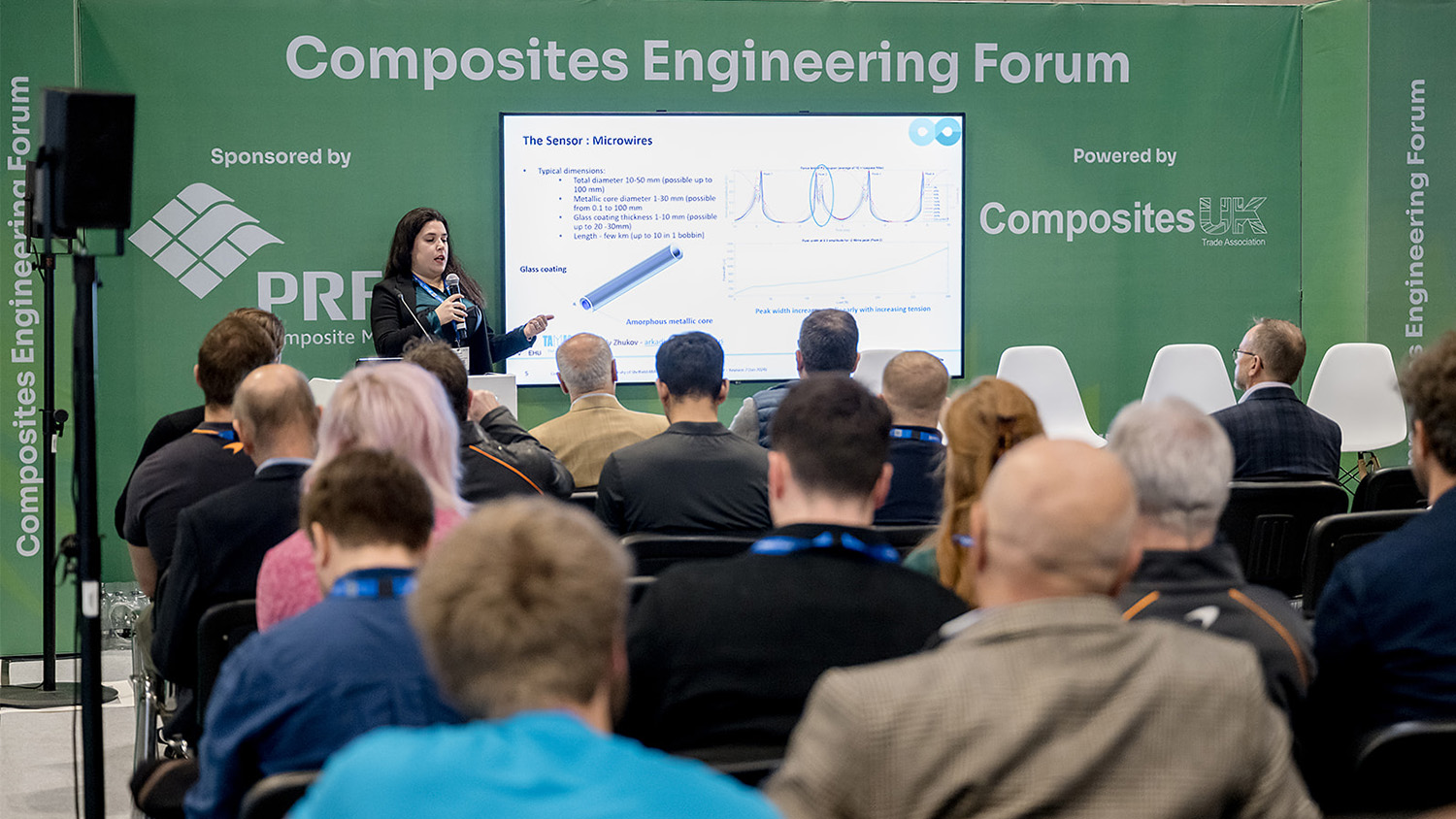
Advanced Engineering 2026 reflects that broader view of composites. The Composites Engineering Forum, powered by Composites UK, will focus on designing, manufacturing and industrialising composite solutions at scale, including materials circularity, recycling and end-of-life. Across the wider event, composites companies will also sit alongside machinery, automation, inspection, digital engineering, electronics and supply-chain specialists.
That cross-sector context is important. Composite materials rarely succeed because of material development in isolation. They succeed when the design case, production route, quality system, supply chain and commercial model align strongly enough for an OEM or manufacturer to adopt them with confidence.
The next major step for the UK composites sector may therefore be less about confirming that another advanced material can work and more about making it easier for good technologies to cross the difficult distance between a successful development programme and dependable industrial production.
Advanced Engineering and the Composites Engineering Show take place at the NEC Birmingham on 4-5 November 2026. Registration is free for qualified engineering and manufacturing professionals.