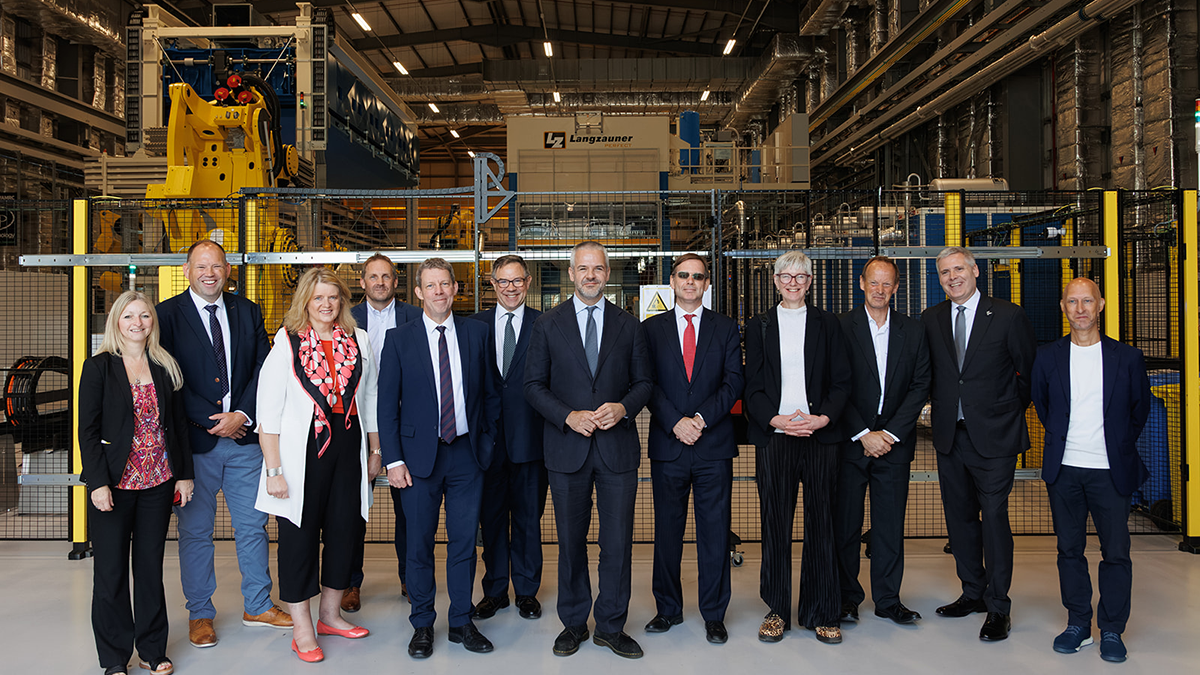
A landmark investment to build next-generation industrial and manufacturing capabilities for future aerospace production has officially opened at the University of Sheffield Advanced Manufacturing Research Centre (AMRC).
The pioneering £54m open-access Composites at Speed and Scale (COMPASS) research and development facility, which has Boeing as its first user, was opened today (Thursday, July 16), bringing together key leaders from across industry, government and academia.
The COMPASS facility is designed to de-risk and accelerate high-rate, large-scale composite production and marks a major step forward to grow the UK economy and secure the long-term future of UK aerospace manufacturing by enabling production at true rate and scale.
As global aircraft demand hit record highs, with more than 40,000 aircraft needed over the next 20 years, the UK industry is making a targeted play to capture a greater share of the multi-billion-pound aerospace export market. COMPASS serves as critical national infrastructure to meet this demand, unlocking the advanced capabilities required to manufacture large-scale aerostructures faster and more efficiently within the UK.
Prof Ben Morgan, chief executive officer at the University of Sheffield AMRC, said: “COMPASS delivers a world-leading capability built on two decades of the AMRC’s industrially relevant composites and automation research.
“To secure the UK’s position as a leading aerospace manufacturing nation, we must de-risk new technologies at scale. This facility will do exactly that, unlocking jobs, attracting investment and driving economic growth.
“This project has been a true collaborative effort. My sincere thanks go to the government’s ATI Programme, the South Yorkshire Mayoral Combined Authority, the High Value Manufacturing Catapult and the University of Sheffield, alongside our technology and research partners Loop and Boeing as we embark on our first landmark project together.”
Boeing is the open-access facility’s first user, marking a major vote of confidence for UK innovation by housing the largest research programme it has ever delivered in the UK, Isothermic High-Rate Sustainable Structures (IHSS). Backed by funding through the ATI Programme, IHSS aims to revolutionise production efficiency, reducing large component manufacturing times from approximately 40 hours down to just four.
Lane Ballard, chief technology officer of Boeing, said: “Boeing’s IHSS programme at COMPASS demonstrates how advanced composites, automation and digital technologies can deliver high-rate, large-scale production that supports high-value manufacturing jobs. Boeing is firmly committed to the UK’s workforce, supply chain and manufacturing ecosystem, turning initiatives like IHSS into scalable production capability and strengthening the country’s position as a global aerospace leader.”
The IHSS project is dedicated to developing and testing new technologies needed to meet future demand for lighter commercial aircraft and help the aviation industry’s commitment reach net zero by 2050. It builds on Boeing’s long-standing commitment to the United Kingdom, and to South Yorkshire specifically, following the opening of its first European manufacturing facility in Sheffield in 2018.
Loop Technology is a key partner in both the COMPASS facility and the Boeing-led IHSS project. The company’s innovative FibreLINE robotic preforming system enables ultra-high-rate composite manufacturing, dramatically increasing efficiency for manufacturing large aerospace components.
In addition, Loop Technology serves as the robotic systems integrator, ensuring seamless integration and operation of all the equipment as a fully sequenced, end-to-end manufacturing solution
Alun Reece, chief executive officer of Loop Technology, said: “It is deeply gratifying to see the COMPASS facility open its doors. Since the initial conception in 2019, this project has demanded vision, dedication, and outstanding teamwork from all the partners. Today marks a significant milestone, bringing us one major step closer to our goal of manufacturing composite aerostructures at greater speed and scale.”
To meet soaring global production targets and achieve the UK’s net-zero ambitions, the manufacturing industry must move beyond traditional, manual processes. COMPASS addresses this head-on by combining advanced composites with Industry 4.0 digital technologies – including closed-loop machine vision and digital twin modeling – that reduce material waste, component weight and defects while optimising cycle times.
By proving these capabilities at technology readiness level (TRL) six, the facility de-risks high-rate manufacturing for the entire supply chain. It also removes the high cost-barriers of advanced industrial equipment, allowing UK companies, including small-and-medium enterprises (SMEs), to develop more efficient manufacturing solutions so they can compete within global supply chains.
Key to this is the state-of-the-art equipment within COMPASS funded through a £29.5m grant from the ATI Programme, a partnership between the Aerospace Technology Institute (ATI), Department for Business and Trade and Innovate UK.
Gary Elliott, chief executive officer of the ATI, said: “The University of Sheffield AMRC has a proud record of providing cutting edge support to the aerospace industry. COMPASS takes that further still, providing a world-leading open-access facility for UK innovation in composites technology, with support from the ATI Programme. This supports our ambition to double UK aerospace market value by 2035, with significant opportunities associated with composites driving jobs and growth across the country.”
The unprecedented scale of the facility centers around Langzauner’s Resin Transfer Moulding (RTM) press – the world’s largest for integral aerostructural parts – boasting a 2,400-tonne pressing force and a tool size of up to 10m x 3m.
Operating adjacent to a 21.4m Zünd cutting table, the cell features an automated FibreLINE deposition system developed by Loop Technology. Here, two 5-metre FibreFORM grippers handle the delicate material, mounted on two of FANUC’s largest industrial robots and supported by three additional FANUC robots. This five-robot fleet operates along an 85m track, leveraging real-time sensor data to dynamically adjust to material behavior during the high-rate build process.
Furthermore, the innovations developed here will extend far beyond aviation, helping the wider UK industry adopt sustainable, cost-effective component solutions across the defence, renewable energy, transport and urban air mobility sectors.
This collaborative investment acts as a cornerstone to attract further global industrial interest. By leveraging the AMRC and University of Sheffield’s R&D capabilities, COMPASS aims to cement South Yorkshire’s position as the premier global destination for advanced manufacturing innovation.
The facility was delivered with core funding support from the South Yorkshire Mayoral Combined Authority (SYMCA), Sheffield City Council, the University of Sheffield and the High Value Manufacturing (HVM) Catapult.
Website: amrc.co.uk