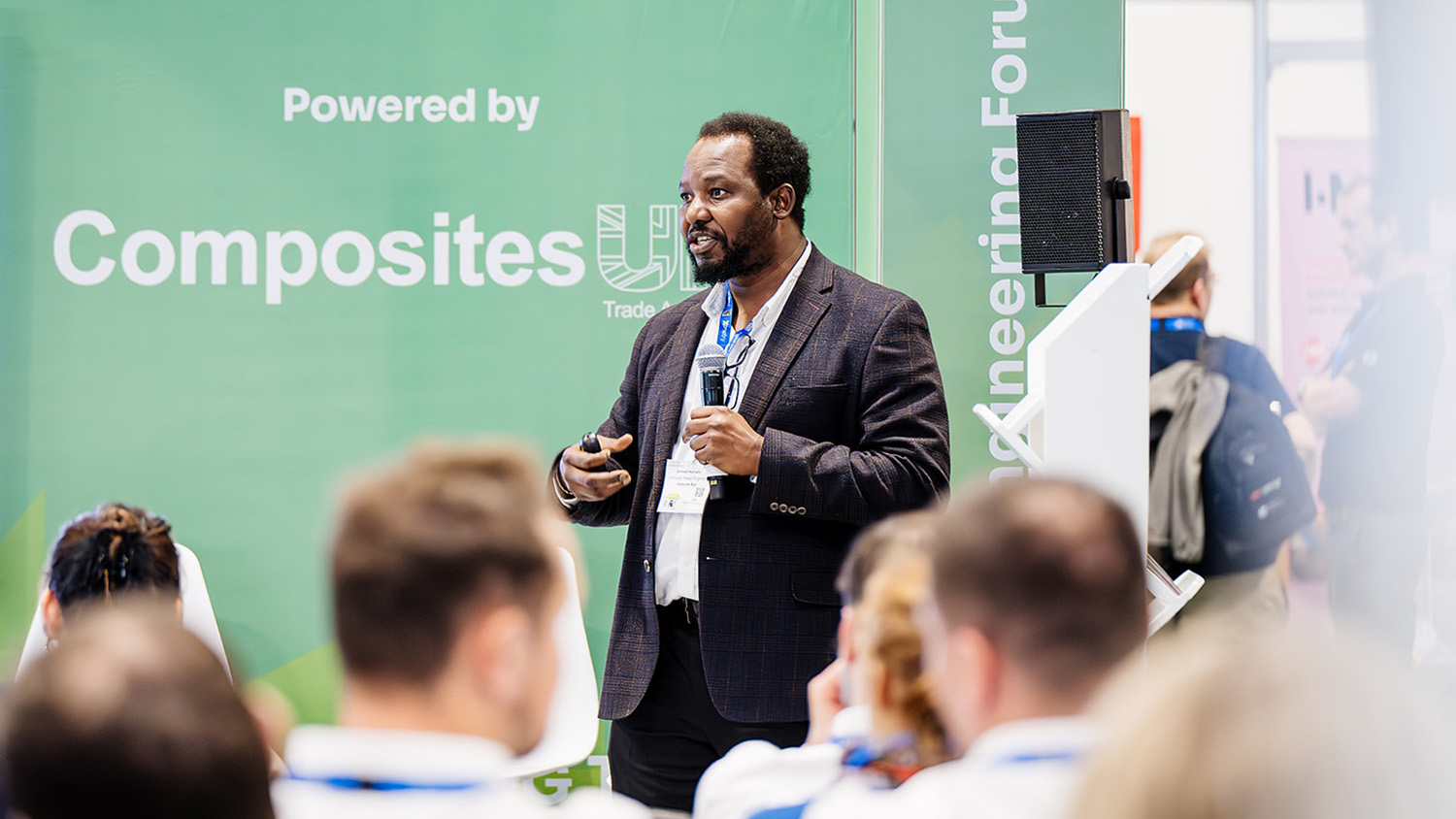
As the UK composites sector looks to convert world-leading technical capability into future manufacturing work, Advanced Engineering 2026 will bring together the companies, technologies and conversations needed to tackle the next challenge: industrialisation.
The UK does not need another reminder that it is good at composites. The more urgent question is whether that capability will translate into the next generation of production work.
That question will be particularly relevant when the composites industry gathers at Advanced Engineering at the NEC Birmingham on 4 and 5 November. With a dedicated Composites Engineering Zone, a two-day forum, and businesses spanning materials, processing, automation, tooling, testing and manufacturing, the event provides an opportunity to look beyond individual innovations and consider what the sector needs to industrialise at scale. Advanced Engineering Birmingham.
The timing is significant. At Farnborough International Airshow this summer, the Aerospace Technology Institute launched A Framework for Growth: Securing the UK’s Composites Advantage, setting out how the UK could capture a greater share of an aerospace composites market forecast to grow from £726 million in 2022 to more than £4.5 billion by 2050.
There is considerable opportunity, particularly as the next generation of ultra-efficient aircraft is expected to increase the use of composites across wings, engines and systems, all areas in which the UK already has significant capability. However, ATI’s message is equally clear: securing that work will depend on demonstrating integrated, certifiable and scalable industrial systems capable of designing, manufacturing, qualifying and delivering high-value composite products at significantly increased rates.
That changes the composites conversation.
For years, much of the industry’s attention has understandably focused on material performance, lightweighting, and the ability to create structures that would be difficult or impossible to achieve with conventional materials. Those advantages remain important, but future competitiveness will increasingly depend on what happens around the material.
Can a process that works successfully on a demonstrator deliver hundreds or thousands of repeatable parts? Can quality be designed and monitored into production rather than inspected afterwards? Can tooling respond to faster development cycles and higher manufacturing rates? Can automation reduce cost without sacrificing flexibility? Are material and manufacturing supply chains resilient enough to support programmes that may run for decades?
These are also the questions running through the composites programme at Advanced Engineering this year.
Rather than structuring the Composites Engineering Forum solely around new materials or isolated technical developments, a two-day programme has been curated that examines the broader path from market opportunity to industrial adoption. The agenda considers where future demand is coming from, what customers will require, how the industry can improve manufacturing rates and costs, the role of digitalisation and automation, approaches to quality, and the practical challenge of making composites more sustainable.
The mix of contributors is important. Speakers include representatives from GKN Aerospace, Spirit AeroSystems, the National Composites Centre, Airborne UK, Cygnet Texkimp and others, bringing perspectives from end users, research organisations, equipment providers and the wider composites supply chain.
That breadth matters because the barrier to greater adoption of composites is rarely the material alone.
A manufacturer trying to increase production rates may need better automation or more adaptable tooling. A designer seeking to reduce environmental impact needs to understand not only material performance but also manufacturing efficiency and end-of-life options. An aerospace programme evaluating a new structure requires capabilities in design, materials, tooling, production, inspection, qualification, and certification before that technology can move confidently into service.
Advanced Engineering is particularly useful in this respect because the composites sector sits within a much wider engineering environment. Visitors can move from composite materials and processing into automation, robotics, additive manufacturing, advanced materials, aerospace, automotive and electrification, creating opportunities to explore technologies that may not traditionally sit within the same supply chain. The event will host more than 200 speakers across its technical forums. At the same time, the Composites Networking Lounge will provide dedicated networking across markets, including aerospace, automotive, defence, marine, renewable energy, medical, motorsport and sports.
Sustainability will form an increasingly important part of those conversations. The challenge is moving beyond proving that a composite can technically be recycled to creating viable systems in which recovered materials can be processed consistently, specified with confidence, and used in applications that support the economics of recovery.
Again, this is as much an industrialisation problem as an environmental one. A recycling technology creates limited value if there is no reliable feedstock, qualification route, manufacturing process or market for the material it produces.
This is perhaps why the conversation about composites at Advanced Engineering feels particularly relevant in 2026. The industry is no longer simply asking what composites can do. Increasingly, it is asking how those capabilities can be manufactured faster, more consistently, and more economically; where future demand will come from; and what the UK needs to retain the value created by its technical expertise.
The UK already has considerable composites capability. The opportunity now is to turn that strength into production capacity, stronger supply chains and long-term industrial value.
The next phase of UK composites leadership will not be measured only by what the country invents. It will be measured by what it can industrialise, manufacture competitively and retain as long-term UK workshare.
Advanced Engineering 2026 takes place at the NEC Birmingham on 4 and 5 November. Composites UK returns as headline industry partner, with the Composites Engineering Forum, Composites UK Pavilion and wider Composites Engineering Zone bringing together organisations from across the UK supply chain.
Registration is free for qualified engineering and manufacturing professionals. advancedengineeringuk.com.