Engineered Composites Limited’s considered and cautious position has long been that GRP had always won on whole-life cost, and that the upfront price gap against steel was beginning to narrow. That position, it now acknowledges, was too cautious. The gap has not narrowed. It has closed and then gone the other way.
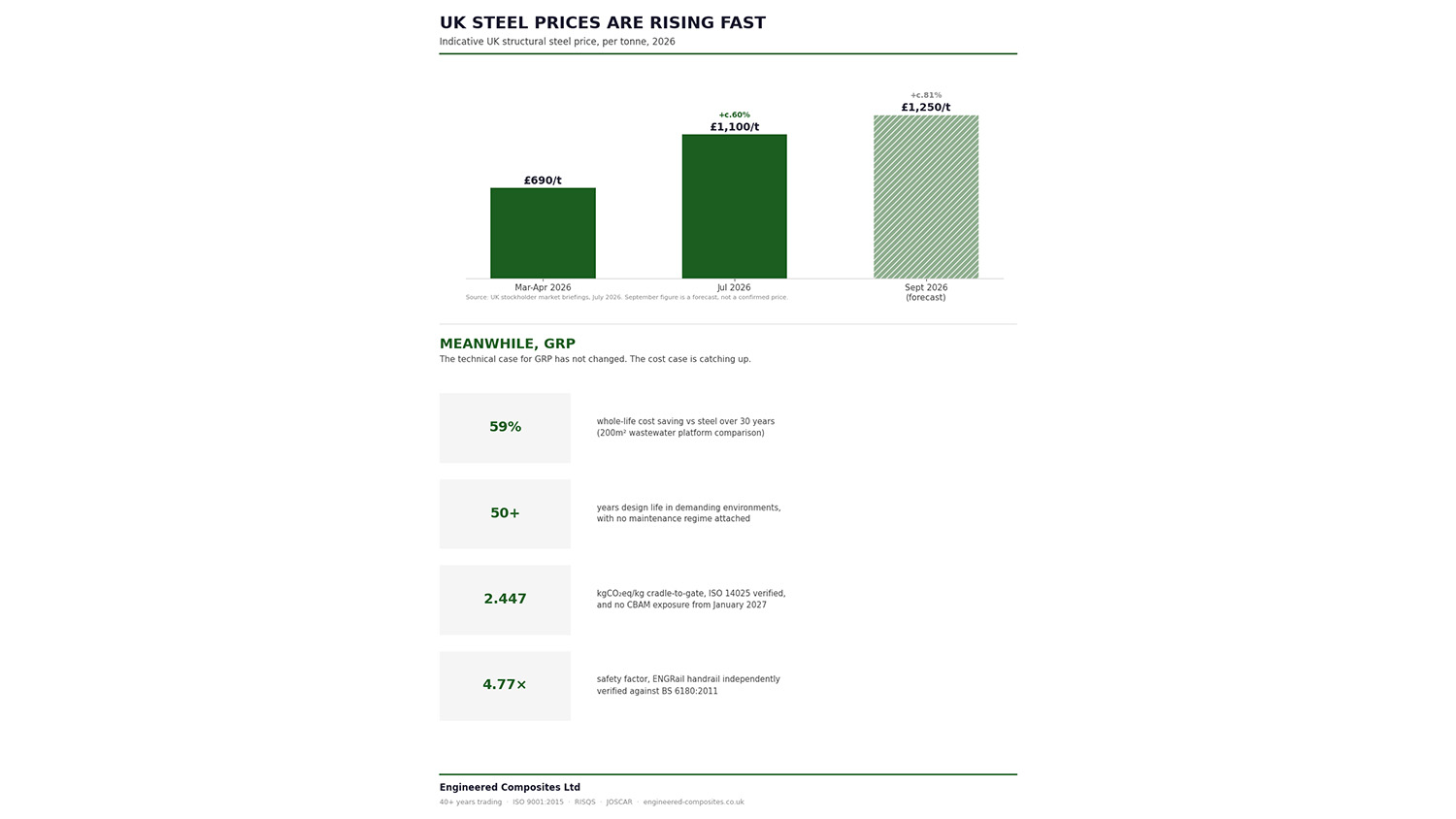
UK structural steel that was trading at £680 to £700 per tonne three to four months ago is now £1,100 per tonne. Stockholders are openly briefing customers to expect £1,250 per tonne in September. That represents an increase of roughly 80 per cent within two quarters, on a product whose demand is weak rather than booming.
| UK structural steel | Mar-Apr 2026 | July 2026 | Sept 2026 (fcst) |
| Indicative price per tonne | £680 – £700 | £1,100 | £1,250 |
| Movement from baseline | n/a | +c.60% | +c.81% |
Indicative UK structural steel pricing, March to September 2026. Source: UK stockholder market briefings, July 2026.
This Is Not the 2021 Spike. This One Does Not Come Back Down.
During Covid, steel prices doubled and specifiers rode it out because everyone understood the cause was a demand shock and that a correction would follow. It did. Prices fell back.
What is happening now is structurally different, and that is the part the market has not yet fully priced in. Demand today is soft. Order books are quiet. Sites are shut for August. In any normal cycle, that would mean falling prices. Instead, prices are climbing sharply because the pressure is not coming from demand at all. It is coming from policy and the cost of production.
- Mill-level increases across Europe. ArcelorMittal has implemented a €25 per tonne increase across long products, covering commodity sections, rebar and wire rod. The pressure feeds through to virtually every UK stockholder, as they are supplied by the same source in one form or another.
- Energy and freight. Renewed conflict in the Middle East is driving gas, electricity and freight costs into production and distribution simultaneously.
- UK trade policy. Import quotas were cut by around half from 1 July, with a 50 per cent tariff layered on top. Sharply reduced quota allocations on rebar and wire rod are tightening supply further.
- UK Steel Strategy and nationalisation. Government policy surrounding British Steel is reshaping the domestic supply base, with the associated costs being passed downstream.
- CBAM lands January 2027. The Carbon Border Adjustment Mechanism adds a minimum of £75 per tonne on top of existing costs. That is not a forecast; it is legislated.
Taken together, the September restart looks less like a recovery and more like a step change, with tighter supply, higher input costs and returning demand arriving simultaneously.
The Old Argument for GRP Is Now Obsolete
For twenty years, the honest position on GRP was straightforward: expect to pay around 20 per cent more upfront and recover that cost many times over during the life of the asset through zero repainting, zero corrosion repair and no mid-life replacement. It was a strong argument, but also a patient one—and patient arguments tend to lose to immediate budget pressures.
That trade-off no longer exists.
On a growing proportion of enquiries received by Engineered Composites Limited, GRP is now the cheaper option on day one as well as the cheaper option over thirty years. The whole-life case has not weakened at all. The company’s own comparison of a 200 square metre industrial platform in a wastewater environment demonstrated a 59 per cent whole-life saving for GRP over 30 years. That saving remains and now sits on top of a lower purchase price rather than behind a higher one.
Any project being priced against a steel budget figure established six months ago is almost certainly working from outdated assumptions.
What Comes Alongside the Lower Price
The commercial case has changed, but none of the technical reasons for specifying GRP have.
- No corrosion. No galvanising, no paint systems, no sacrificial coatings, no rust in chlorinated, saline or effluent environments.
- Non-conductive and non-magnetic. Critical for rail trackside, substations and utilities work.
- Roughly a quarter the weight of steel. Two-man handling instead of lifting plant. Faster installs, smaller crews, shorter possessions, lower access costs.
- 50-year-plus design life in demanding environments, with no maintenance regime attached to it.
- Verified carbon performance. ISO 14025 Environmental Product Declaration at 2.447 kgCO₂eq/kg cradle-to-gate, and no CBAM exposure in January 2027.
- Independently tested structural performance. Our ENGRail 51mm box-section modular handrail, the world’s first, was verified by an independent UKAS-accredited test house to exceed BS 6180:2011 at a 4.77× safety factor.
- Fire certified. SGS-tested to EN 13501-1, Class B-s1,d0.
There is a second consideration worth making, and it concerns availability rather than price. As quotas tighten and mills emerge from August shutdowns into a constrained market, steel lead times may become the risk that few project budgets have accounted for.
Engineered Composites Limited maintains substantial UK stock across pultruded profiles, grating, handrail, ladders, fencing and rebar, supported by an established supply chain and approximately 70 containers per annum of planned imports. The company operates as both a manufacturer and a stockholder. For most standard products, delivery times are measured in days rather than weeks.
The Company’s View
“A month ago, Engineered Composites Limited stated that the price gap between GRP and steel was closing. That assessment was already out of date by the time it was published. Steel at £1,100 per tonne, heading towards £1,250, with CBAM still to land, has done more for the composites case in one quarter than twenty years of arguing whole-life cost. GRP is now frequently the cheaper option on day one and remains dramatically cheaper across the life of the asset. Anyone specifying steel out of habit rather than calculation is now paying a premium for the privilege.”
Gavin Williams, Managing Director, Engineered Composites Limited, and Vice-Chair of the Composites UK Construction Sector Group.